


Which Vulnerabilities Can Attackers See in Your Domains?
Lupasafe continuously scans your domains and IP addresses for weaknesses that attackers exploit — open ports, expired certificates, email security gaps. Every finding is risk-scored so you know what to fix first.
Trusted by 600+ organisations • Gartner Peer Insights ★★★★★ 5.0
Trusted by 600+ organisations




 ★★★★★5.0
 Horizon 2020
What is domain and IP vulnerability scanning?
Domain scanning — also known as vulnerability scanning or external security monitoring — is the continuous checking of your digital infrastructure for weaknesses that attackers can exploit. Think open ports, expired SSL certificates, missing security headers and misconfigured email security.
Lupasafe combines domain and IP scanning with email security analysis in one platform. Every vulnerability is assessed using CVE classification, CVSS 3.0 severity and EPSS exploit probability, so you know what requires immediate action — and what can wait.
Why vulnerability scanning is urgent now
Four reasons not to wait any longer.
NIS2 requires it
The NIS2 Directive requires organisations to identify and remediate vulnerabilities in their network and information systems. Scanning is no longer optional.
Attackers are already scanning you
Automated scanners search 24/7 for open ports, outdated software and misconfigurations. What they find, you should know first.
Supply chain effect
Clients subject to the NIS2 Directive require their suppliers to demonstrate that they actively manage vulnerabilities.
One-off is not enough
New vulnerabilities emerge daily. One-off penetration tests are valuable, but continuous monitoring is what auditors expect.

“Lupasafe makes it harder for hackers to find vulnerabilities.”
Pieter Willemsen
CEO, Hupra ICT
All vulnerabilities in one dashboard
No separate tools, no spreadsheets. One overview of all domains, IP addresses and email configurations — prioritised by actual risk.
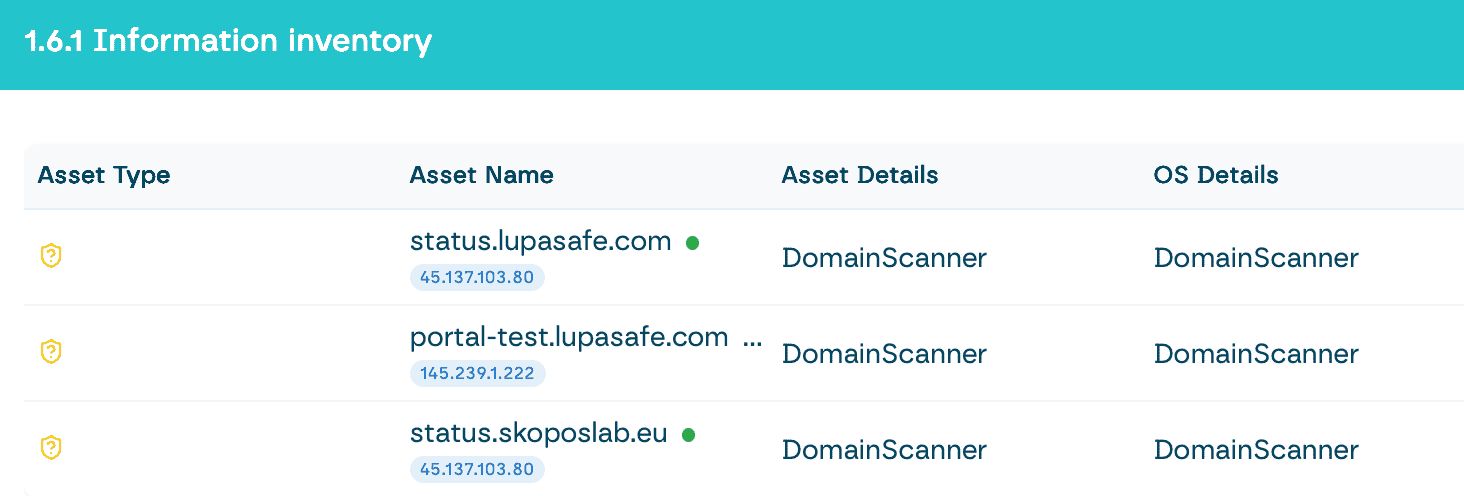
One place for all scan results. Share with your IT team, MSP or auditor. Download everything for your NIS2 compliance dossier. One source of truth.
How it works
From sign-up to a complete vulnerability overview in three steps.
Add your domains and IP addresses
During the free evaluation, enter your domains, subdomains and external IP addresses. Lupasafe automatically detects related assets.
Lupasafe scans automatically
Continuous scanning for open ports, expired certificates, missing headers, DNS issues and email configuration. Every finding receives a CVE classification, CVSS 3.0 score and EPSS risk assessment.
Receive a prioritised action plan
No list of 200 findings without context. Lupasafe shows what is urgent based on the probability that a vulnerability will actually be exploited — so you fix the right things first.
Three pillars that feed your compliance dashboard
Every module delivers immediate insight. All results flow automatically into your NIS2 reporting.
People
Know who is vulnerable — and make them more resilient.
40% of employees enter credentials at the first phishing test. Continuous training and testing reduces it measurably over time.
- Phishing simulations — email, QR code, credential harvest
- E-learning — role-specific, NIS2 functions, annual planning
- Dark web monitoring — 20 billion+ leaked records
Technology
Discover vulnerabilities before an attacker does.
Your attack surface changes continuously. Lupasafe scans your domains, endpoints, network and cloud — automatically, weekly.
- Endpoint compliance — Windows, macOS, Linux, CVE matching
- Microsoft 365 audit — Secure Score, MFA status
- Domain scanning — ports, SSL, security headers
- DMARC — prevent email spoofing
You are here
Compliance
Prove you comply — without spreadsheets.
All scan and training results flow automatically into your NIS2 compliance dashboard. Cyber Fundamental controls, ISO 27001 and Cyber Essentials — in one place.
- NIS2 — Cyber Fundamental controls with evidence
- ISO 27001 — Annex A mapping
- Cyber Essentials — baseline standard
- Policy documents — BCP, backup, remote work
Domain scanning and NIS2 compliance
The NIS2 Directive requires organisations to continuously secure their network and information systems — including identifying and remediating vulnerabilities. Without visibility into your vulnerabilities, you cannot fulfil the duty of care.
Lupasafe automatically generates compliance reports showing which scans you run, what the results are and which actions you have taken. Share these reports with your auditor, management or clients — directly from the platform.
Discover your vulnerabilities before attackers do
Start a free 30-day evaluation. Add your domains and receive your first scan results within minutes.
Trusted by 600+ organisations
Frequently asked questions
What does Lupasafe scan on my domains?
Lupasafe performs a comprehensive scan: SSL/TLS certificates, OWASP security headers (HSTS, CSP, X-Frame-Options, X-Content-Type-Options), DNS configuration, subdomains and known CVE vulnerabilities. It also scans external IP addresses for open ports and running services, and checks your DMARC, DKIM and SPF configuration.
What are CVE, CVSS 3.0 and EPSS?
CVE (Common Vulnerabilities and Exposures) is the standard classification for known vulnerabilities. CVSS 3.0 (Common Vulnerability Scoring System) gives each vulnerability a severity score from 0 to 10. EPSS (Exploit Prediction Scoring System) adds an exploit probability: how likely is it that this vulnerability will be exploited within 30 days? Lupasafe combines all three for a realistic risk profile.
Is vulnerability scanning required under NIS2?
The NIS2 Directive requires organisations to take appropriate measures to secure their network and information systems. Identifying vulnerabilities is a fundamental part of that obligation. Without visibility into your vulnerabilities, you cannot take the right measures.
How does continuous scanning differ from a penetration test?
A penetration test is a snapshot: valuable, but outdated as soon as a new vulnerability is published. Lupasafe scans continuously and automatically, so you know immediately when something changes. The combination of both — periodic pentests plus continuous monitoring — is what auditors and the NIS2 Directive expect.
Read more
Email Security & DMARC
How Lupasafe continuously monitors and reports on your DMARC, DKIM and SPF configuration.
Read more →
Endpoint Compliance
Monitor antivirus status, disk encryption and admin rights across all devices.
Read more →
Security Awareness Training
From 40% click rate to under 8%. How awareness training reduces your human vulnerability.
Read more →
